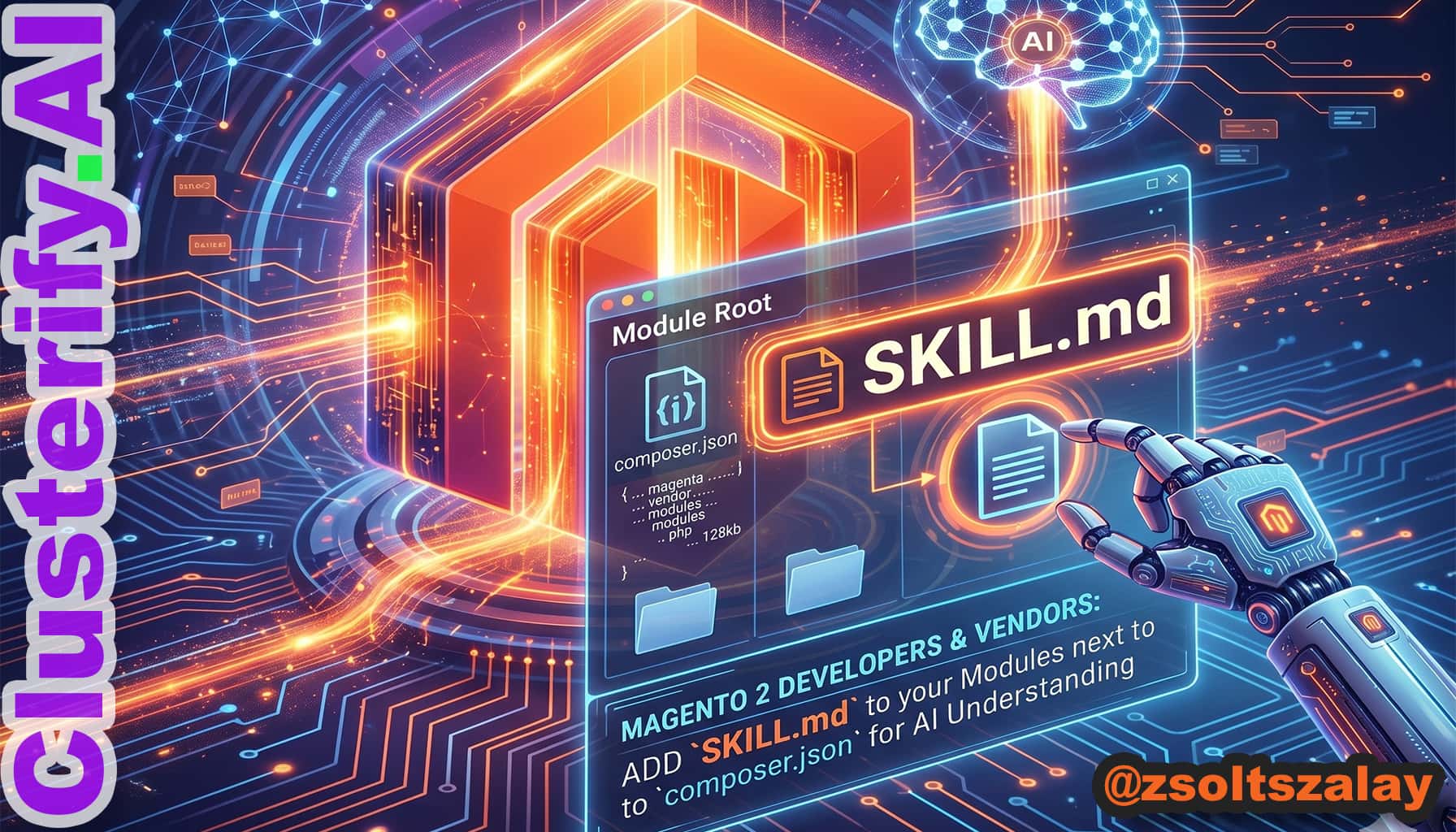
Adobe, Magento partners, extension vendors, agency teams, and open-source contributors: I think it is time to start a serious discussion about adding a SKILL.md file to Magento 2 modules.
This is not just another documentation idea. It is a practical step toward making Magento modules easier for humans to understand, easier for AI tools to use correctly, and less likely to cause confusion during development, integration, debugging, and maintenance.
As AI-assisted development becomes normal across the Magento ecosystem, we need to stop thinking only in terms of PHP classes, XML, DI configuration, service contracts, and README files. We also need to think about how our modules explain themselves to intelligent tools. That is where SKILL.md can become extremely valuable. OpenAI, Anthropic, GitHub Copilot, and Microsoft now all document skills built around a SKILL.md manifest or compatible agent-skill structure, which shows this is moving into the mainstream rather than staying an experimental niche.
What is a SKILL.md file?
A SKILL.md file is a Markdown-based manifest plus instruction file that defines a reusable capability for an AI agent. In the current agent-skills ecosystem, a skill is typically a folder containing a SKILL.md file and, optionally, supporting resources such as scripts, references, templates, or examples. The file usually includes metadata such as a name and description, followed by structured instructions that explain what the skill does, when it should be used, what inputs it expects, how it should behave, and what outputs or checks it should produce.
In simpler words, SKILL.md tells an AI assistant: “When you are dealing with this kind of system, here is the right way to think about it, here are the rules, here is the workflow, and here are the mistakes to avoid.”
That matters because a Magento 2 module is rarely self-explanatory. Even well-written code often hides important assumptions that live only in a maintainer’s head.
Why Magento 2 is a perfect candidate
Magento 2 is powerful, but it is also one of the most convention-heavy and misunderstanding-prone PHP platforms in common use. Small mistakes can create disproportionately large problems:
- the wrong preference or plugin target
- misuse of extension attributes
- incorrect event observers
- misunderstanding of
etc/adminhtml, etc/frontend, and etc/webapi_rest
- broken DI compilation
- cache-related confusion
- assumptions about indexers, cron, queues, or configuration scope
- unsafe overrides of checkout, pricing, customer, catalog, or sales flows
A README.md can explain installation and usage, but it usually does not encode the deeper procedural knowledge of how the module should be modified, extended, debugged, or integrated safely. A SKILL.md can. It is designed for reusable process knowledge, not just general project description. OpenAI describes skills as a way to codify processes and conventions, while Anthropic describes them as specialized capabilities defined in Markdown that agents load when relevant.
Magento 2 modules are full of this kind of process knowledge. In fact, they are almost begging for it.
What a Magento module could teach through SKILL.md
Imagine opening a Magento 2 extension and finding a SKILL.md that explains things like:
- which service contracts are safe extension points
- which classes should never be overridden directly
- which plugins are expected and which are dangerous
- how configuration values flow through the module
- which database tables and indexes are touched
- how cron, consumers, observers, and API endpoints interact
- what to check first when something fails
- what architectural boundaries should be respected
- how to add a new feature without breaking backward compatibility
- how to test the module properly in a real Magento environment
That is far more useful to an AI coding agent than a README that says “Run composer install and enable the module.”
It is also far more useful to a new developer on the team.
Why this helps AI and LLM workflows
AI coding assistants are becoming part of daily development. But they are only as reliable as the context they receive.
Without clear guidance, an LLM may inspect a Magento codebase and make wrong assumptions. It may suggest overriding the wrong class, using an observer where a plugin would be better, bypassing service contracts, duplicating logic that already exists, or missing module-specific constraints entirely.
A SKILL.md gives the model structured project-specific guidance. This reduces ambiguity and helps the model act more like a real maintainer and less like a generic code generator. The newer skill systems from OpenAI, Anthropic, GitHub, and Microsoft all emphasize this same idea: skills package instructions, resources, and conventions so the model can perform better on specialized tasks.
There is another important detail here: modern skill systems use progressive disclosure. Instead of dumping every instruction into the context window all the time, the agent first sees lightweight metadata and only loads the full skill when it becomes relevant. OpenAI documents this behavior for Codex, and Anthropic’s materials describe a similar staged loading model. That means SKILL.md can be rich and useful without always bloating context.
For Magento, this is ideal. A skill could stay dormant until the agent detects that the task involves, for example:
- checkout customization
- payment method integration
- admin UI form troubleshooting
- DI and preference conflicts
- EAV attribute setup
- API service contract design
- cron or message queue behavior
- GraphQL or REST extension
At that moment, the right module-specific knowledge can load.
Why it can reduce issues and misunderstandings
Most Magento problems are not caused by syntax. They are caused by misunderstanding architecture, intent, sequence, or boundaries.
That is exactly the kind of gap SKILL.md can help close.
A strong SKILL.md can tell an agent or developer:
- do not override this block or controller; use the provided service instead
- do not write directly to this table; use the repository or command class
- after changing this config, flush these caches and reindex these indexers
- this observer depends on this event payload structure
- this plugin must remain sort-order sensitive
- this module assumes MSI is enabled
- this feature is store-scope only
- this module integrates with B2B or Adobe Commerce only, not Open Source
- these XML nodes are merged in a non-obvious way
- this code is legacy and should not be copied for new features
That is gold.
It prevents costly detours. It reduces support burden. It shortens onboarding. It improves AI-generated pull requests. And it can lower the risk of bad customizations that later become production bugs.
Why Adobe and core Magento modules should adopt it too
This should not be limited to third-party vendors. Adobe should consider adding SKILL.md files to core Magento modules as well.
Why? Because core modules are exactly where developers and AI systems most often need guidance.
Magento core contains decades of accumulated design decisions, inconsistent patterns across eras, hidden assumptions, deprecated flows, and important extension boundaries that are not always obvious from code alone. If core modules exposed skill files, they could provide AI-readable guidance on intended extension mechanisms, safe customization points, deprecation expectations, testing patterns, and known architectural constraints.
That would benefit:
- extension vendors building on top of core
- agencies customizing projects
- internal Adobe teams
- AI-assisted code review
- onboarding of new Magento developers
- community contributors opening PRs
Core SKILL.md files could also create a de facto standard for how extension vendors should document their own modules.
In other words, Adobe could help define the AI-readable documentation layer for Magento 2.
What could be inside a Magento 2 SKILL.md
A practical module-level SKILL.md might include sections such as:
Purpose
What the module does, in precise Magento language.
When to use this skill
Typical tasks, such as adding a field, extending an API, debugging totals, or integrating a frontend component.
Architectural map
Key services, repositories, XML files, events, plugins, consumers, cron jobs, UI components, and extension points.
Safe customization rules
What to extend, what not to override, and preferred patterns.
Common pitfalls
Known failure modes and misleading assumptions.
Setup and validation
Which cache flushes, reindexes, deployment steps, and tests matter after changes.
Compatibility notes
Magento Open Source vs Adobe Commerce, MSI dependencies, PHP version assumptions, third-party conflicts, or edition-specific behavior.
Example workflows
“How to add a new config field safely,” “How to expose a REST endpoint,” “How to extend order data,” and so on.
This would be enormously useful in real projects.
Some interesting ecosystem signals
This idea is timely because the broader ecosystem is already moving in this direction.
OpenAI documents skills as reusable bundles anchored by a SKILL.md manifest and notes that they are compatible with the open Agent Skills standard. Anthropic documents a similar model for Claude Code, where a SKILL.md file adds a new capability to the toolset. GitHub Copilot now supports agent skills, and Microsoft’s Agent Framework also documents agent skills as portable packages following an open specification.
There are also a few interesting quantitative signals around the format and its usage patterns:
OpenAI’s public openai/skills repository already exposes a sizable catalog of curated and experimental skills, and Anthropic’s public skills materials recommend keeping always-loaded metadata small while loading the full body only when needed. Anthropic’s example guidance describes a three-level loading system where metadata is always present and the full SKILL.md loads only when triggered.
Beyond the core vendors, one ecosystem article describes skill.md as installable into “20+ major coding agents,” while an adjacent AGENTS.md convention is described as being used across “60,000+ open-source projects.” That second number is about AGENTS.md, not SKILL.md, so it should not be conflated, but together they do suggest that machine-readable guidance files are moving quickly from experiment to convention.
So even if Magento has not standardized this yet, the direction of travel is clear.
Why vendors should care right now
Extension vendors often spend huge time on support tickets that are really documentation failures in disguise.
A merchant’s agency integrates the module incorrectly.
A developer overrides the wrong class.
A team assumes the module supports a flow it never intended to support.
An AI assistant generates code that “looks Magento-ish” but violates the vendor’s architecture.
A good SKILL.md can reduce all of that.
It becomes a bridge between code, docs, maintainers, and AI tools.
It can also become a competitive advantage. Vendors who provide AI-readable module guidance may see:
- faster integration success
- fewer broken customizations
- better support efficiency
- more accurate AI-assisted development
- stronger trust from agencies and enterprise teams
In a world where more code is first drafted with AI, the modules that explain themselves best may win.
A possible Magento community standard
I would love to see the Magento community define a lightweight convention, something like:
Vendor/Module/SKILL.md
Or perhaps:
docs/SKILL.md
With optional supporting files such as:
docs/architecture.mddocs/troubleshooting.mddocs/examples/add-new-attribute.mddocs/examples/extend-api.md
Even a minimal standard would help if it answered a few key questions consistently:
- What does this module do?
- When should an AI agent load this skill?
- What are the supported extension points?
- What are the dangerous anti-patterns?
- How should changes be validated?
That alone would make many Magento projects safer.
Final call to Adobe, partners, and the community
I believe SKILL.md could become one of the most practical new documentation layers for Magento 2.
Not flashy.
Not theoretical.
Just useful.
It can help AI tools understand modules more accurately.
It can help developers avoid mistakes.
It can help vendors communicate architectural intent.
It can help Adobe make core Magento easier to extend safely.
And it can help the whole ecosystem move toward clearer, more maintainable, AI-ready engineering.
So this is my call to action:
Adobe, Magento partners, extension vendors, agencies, and open-source maintainers: let’s start discussing whether every serious Magento 2 module should ship with a SKILL.md file.
Because the future is not just code that runs.
It is code that can explain itself clearly to both humans and machines.