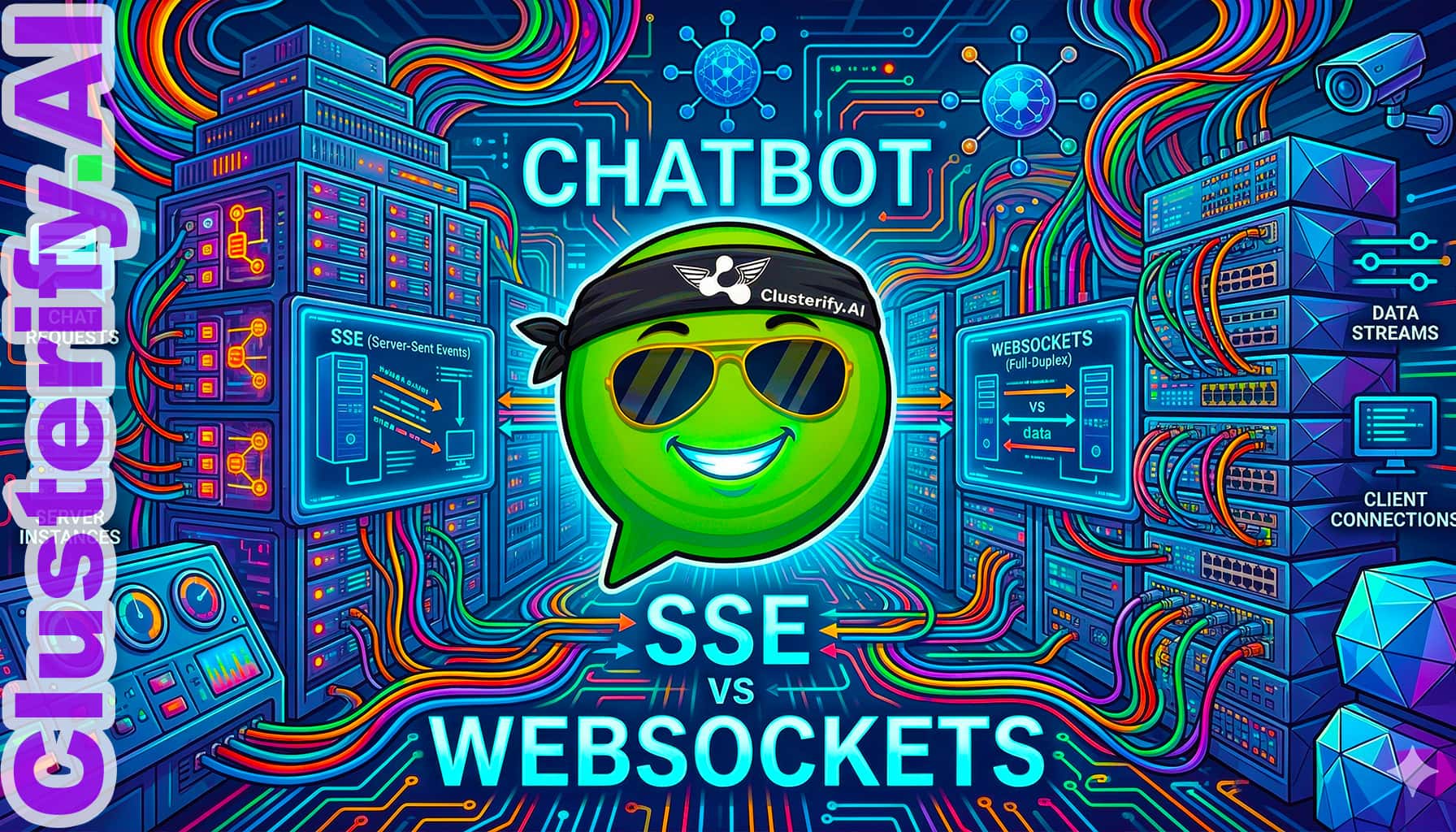
Choosing the right streaming protocol for a Chatbot SaaS in 2026 isn’t just about “real-time” speed—it’s about balancing cloud costs, architectural simplicity, and the specific “bursty” nature of Large Language Model (LLM) responses.
While WebSockets were the historical go-to for chat for sevaral reason, Server-Sent Events (SSE) have become the industry standard for Generative AI platforms like ChatGPT and Claude and I understand why.
1. Architectural Philosophy
The fundamental difference lies in the direction of the “conversation” between the client and the server.
- WebSockets (Bi-directional): Think of this as a phone call. Both parties can talk at the same time. The connection starts as HTTP and “upgrades” to a persistent TCP-based WebSocket protocol.
My view:
It also means you need to keep open a connection on your server(s) for each clients who has your Chatbot in the browser. If that number is small then you are good, but as numbers are growing this can be a problem (at least will cost you).
- SSE (Unidirectional): Think of this as a radio broadcast where the listener can call in on a separate line. The client opens a standard HTTP connection, and the server keeps it open to “stream” data chunks.
My view:
Less mamory usage, and most importantly NATIVELY reconnects if any issue is there. Enterprise grade reliability. And this is serious issue die to agressive browser rules to save memory, which makes sence. To kell connections when you close your laptop, or just go to another tab etc… that can be a pain for you.
Also much easier to handle it with kuberneties and proxies…
Impact on Chatbot SaaS:
Most AI chatbots follow a Request -> Stream Response pattern. The user sends a prompt (one-way), and the AI streams back tokens (one-way). Since the user rarely sends data while the AI is generating, the “bi-directional” power of WebSockets is often underutilized.
2. Server Resources & Scalability
In a SaaS model, profit margins depend on how many concurrent users you can support per dollar of infrastructure.
| Feature |
SSE |
WebSockets |
| Protocol |
Standard HTTP/2 or HTTP/1.1 |
Custom (ws:// or wss://) |
| Memory Hook |
Very Low (Stateless-ish) |
Higher (Stateful) |
| Load Balancing |
Works with standard LBs |
Requires “Sticky Sessions” |
| Reconnection |
Native / Automatic |
Manual implementation required |
| Memory |
Less |
More |
The “Sticky Session” Headache:
WebSockets require the client to stay connected to the exact same server instance. If your SaaS uses an Auto-Scaling Group, moving a WebSocket client to a new server during a scale-up event is complex. SSE, being based on standard HTTP, is much easier to route through modern load balancers (like AWS ALB or Nginx) without special configuration.
3. Communication Patterns for LLMs
The “Token Stream” is the soul of the modern chatbot. Users expect to see the AI “typing” in real-time.
The SSE Approach (Recommended for AI)
SSE is natively designed for streaming text. It uses the text/event-stream MIME type, which allows the browser to process partial data as it arrives.
Server-Side (Node.js/Express):
app.get('/chat-stream', (req, res) => {
    res.setHeader('Content-Type', 'text/event-stream');
    res.setHeader('Cache-Control', 'no-cache');
    res.setHeader('Connection', 'keep-alive');
    // Simulate LLM token generation
    const interval = setInterval(() => {
        const token = { text: "Hello " };
        res.write(`data: ${JSON.stringify(token)}\n\n`);
    }, 100);
    req.on('close', () => clearInterval(interval));
});
The WebSocket Approach
WebSockets are better if your chatbot has multimodal requirements—like a voice-to-voice bot where the user and AI might interrupt each other in real-time.
Server-Side (ws library):
const wss = new WebSocket.Server({ server });
wss.on('connection', (ws) => {
    ws.on('message', (message) => {
        // Process user input
        console.log(`Received: ${message}`);
        // Start streaming response back
        ws.send(JSON.stringify({ token: "Thinking..." }));
    });
});
4. Specific Considerations for SaaS
If you are building a production-grade SaaS, consider these three “hidden” factors:
- Corporate Firewalls: Many restrictive corporate networks block non-standard protocols like WebSockets. SSE travels over standard Port 443 (HTTPS), making it nearly impossible to block without breaking the internet.
- Browser Limits: Browsers limit SSE to 6 concurrent connections per domain if using HTTP/1.1. For a SaaS dashboard with multiple open tabs, this can be a bottleneck unless you use HTTP/2, which effectively removes this limit.
- Battery Life: On mobile devices, maintaining a “naked” TCP socket (WebSocket) is often more taxing on battery life than an optimized HTTP/2 stream (SSE).
Which should you choose?
Choose SSE if: You are building a ChatGPT-style interface where the primary goal is streaming text tokens to the user. It is cheaper to scale, easier to debug, and more resilient to network drops.
Choose WebSockets if: Your chatbot is “Agentic” and requires the user to interact with the UI (clicking buttons, dragging elements) while the AI is generating, or if you are building a real-time voice-based assistant.
ChatBot/Assistant FAQ: SSE vs. WebSockets
Why is SSE preferred for LLM token streaming?
SSE is designed specifically for unidirectional text streams. Since LLMs generate one token at a time, the `text/event-stream` format allows the browser to process partial data chunks immediately without the overhead of a full bi-directional handshake.
How does SSE handle automatic reconnections?
Unlike WebSockets, the EventSource API has built-in retry logic. If the connection drops, the browser automatically attempts to reconnect. You can even send a `retry:` field from the server to tell the client how long to wait before trying again.
What is the “6-connection limit” and how do I bypass it?
When using HTTP/1.1, browsers limit you to 6 concurrent SSE connections per domain. This is bypassed by using **HTTP/2**, which multiplexes streams over a single TCP connection, effectively allowing hundreds of concurrent streams.
Do WebSockets require “Sticky Sessions” for scaling?
Yes. Because WebSockets are stateful and persistent, your Load Balancer must support affinity to ensure the client keeps talking to the same pod/server. SSE is easier to scale as it follows standard HTTP routing patterns.
Can I send custom headers with SSE?
The native `EventSource` API does not support custom headers (like `Authorization`). To get around this, engineers typically use polyfills like `fetch-event-source` which allow POST requests and custom headers for Auth tokens.
When is a WebSocket actually better for a chatbot?
WebSockets win if you need full-duplex communication. Examples include real-time voice-to-voice bots, collaborative “whiteboard” bots, or interfaces where the user needs to interrupt the AI mid-stream.
What is the impact on server memory?
WebSockets maintain a continuous open socket which can be memory-heavy on the server as user count grows. SSE, while also keeping a connection open, is generally more lightweight as it leverages standard HTTP/2 multiplexing.
How do proxies (like Nginx) affect these protocols?
Nginx requires specific config for WebSockets (`Upgrade` headers). For SSE, you must ensure `proxy_buffering` is turned off, otherwise Nginx will “hold” the tokens until the buffer is full, breaking the real-time experience.
Realted Linkedin post here