If you’ve worked in B2B procurement or supplier integrations, you’ve probably touched cXML (commerce eXtensible Markup Language)—the “business document over HTTP” workhorse behind PunchOut catalogs, purchase orders, ship notices (ASNs), invoicing, and a lot of supplier enablement at scale.
Even though “cXML 1.2” sounds like a single release, in practice it’s a living 1.2.x line with frequent incremental updates. The official downloads page lists a current spec version in the 1.2.06x range (for example “Current Specification (Version 1.2.069)”).
Quick refresher: what cXML is (in “systems” terms)
cXML is a document protocol: you POST XML payloads representing business documents (setup requests, orders, invoices, etc.) between buyer systems, networks, and suppliers. The core wrapper is always:
-
<cXML payloadID="..." timestamp="..." version="...">
-
<Header> (From/To/Sender credentials)
-
<Request> / <Response> / <Message> (the actual business document)
The official site describes it as a streamlined protocol for consistent communication of business documents between procurement systems.
What’s new in “recent” cXML 1.2.x?
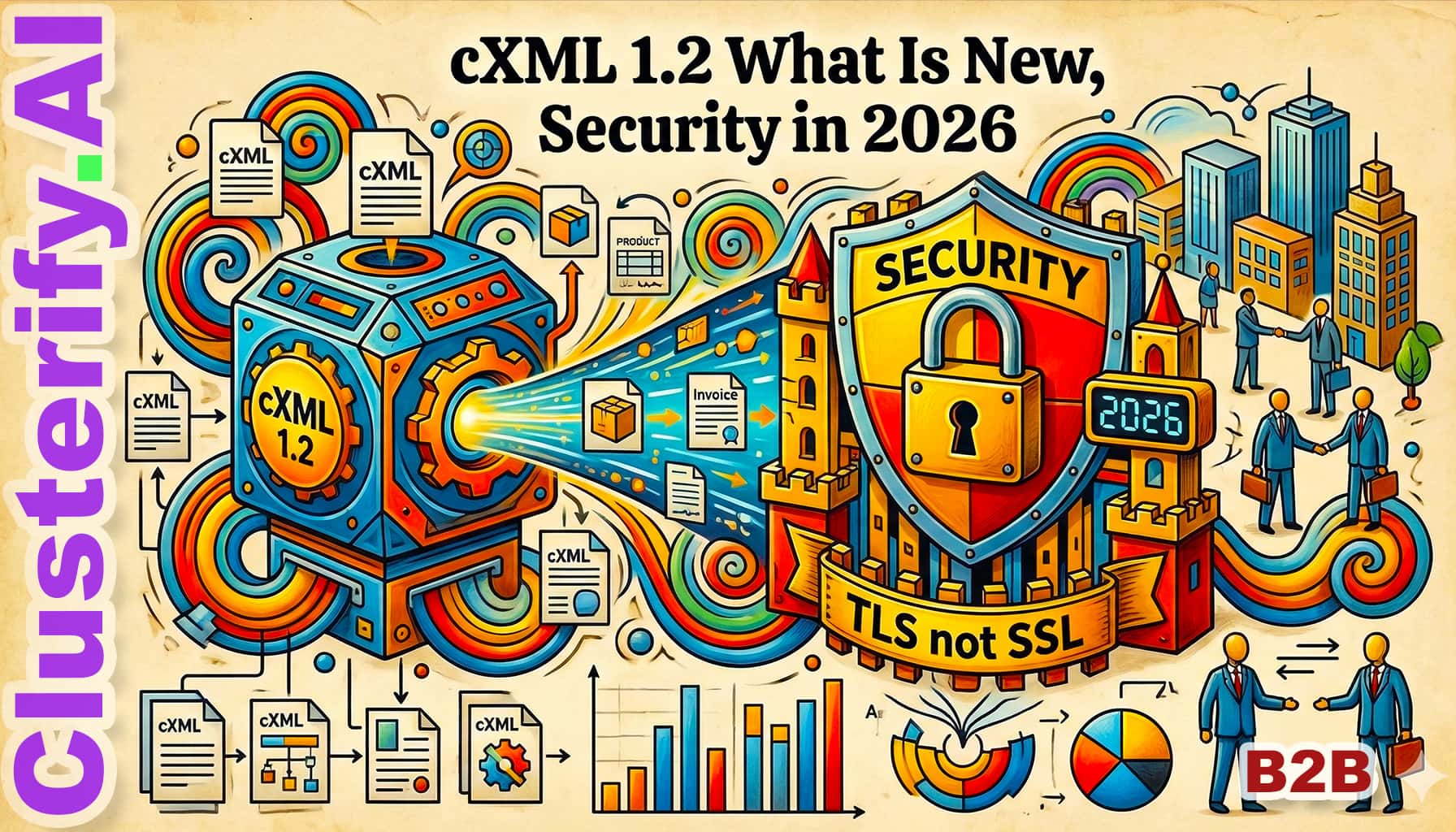
1 – Security baseline modernization: “TLS, not SSL”
cXML (Commerce XML) version 1.2—especially in B2B procurement and PunchOut integrations—uses HTTPS to protect data in transit. In practice, this means your integrations should support TLS 1.2 or newer. Many procurement platforms and networks (including SAP Business Network) are deprecating older protocols such as TLS 1.0/1.1 and requiring TLS 1.2 (and increasingly TLS 1.3) for secure connectivity.
If you run Magento 2, be aware that some cXML/PunchOut functionality may depend on third-party extensions. It’s recommended to confirm with your extension vendors that their components are compatible with modern TLS requirements and are kept up to date.
If your web server is already configured for TLS 1.2/1.3 and your dependencies are current, no changes may be needed—but it’s still advisable to verify your TLS configuration to avoid unexpected connection failures.
Key Aspects of cXML 1.2 and TLS 1.2:
- Security Standard: SAP Ariba and other major B2B networks require TLS 1.2 or higher for secure, encrypted cXML communication.
- Protocol Support: cXML 1.2 applications use HTTPS to transfer data, and modern security policies require disabling outdated protocols like SSL v3, TLS 1.0, and TLS 1.1 to prevent vulnerabilities.
- Authentication: TLS 1.2 handshake secures the connection between trading partners (e.g., a supplier and a buyer’s procurement system).
- Compliance: Using TLS 1.2 is essential for ensuring data integrity and preventing unauthorized access to sensitive procurement data (POs, Invoices, PunchOut messages).
Why you care: fewer exceptions to modern platform security standards, fewer corporate network blocks, and less bespoke security negotiation.
2 – Better order lifecycle + status semantics (OrderStatusRequest, confirmations, etc.)
Later 1.2.x revisions expanded status and confirmation constructs—e.g., OrderStatusRequest and related elements such as ConfirmationStatus, ConfirmationItem, and request header/item structures. These appear in the 1.2.x revision history as added/updated topics.
Why you care: status in B2B is messy (partial shipments, substitutions, backorders). More explicit request/confirmation vocabulary helps reduce custom “status over email” hacks and makes reconciliation easier.
3 – ShipNoticeRequest / ASN evolution (plus ShipControl)
Recent updates also expanded ShipNoticeRequest (ASNs), including structures like ShipNoticeHeader, ShipControl, ShipNoticePortion, and industry-specific ship-notice details.
Why you care: ASNs are where warehouses either run smoothly or burn down. Cleaner ASN semantics reduce “what actually shipped?” disputes and improve inbound receiving automation.
4 – Industry-specific extensions (Aerospace & Defense, Life Sciences)
The release notes show ongoing additions for industry compliance and traceability. Examples include:
-
AerospaceAndDefense elements extending order header/item structures (including DPAS-related handling)
-
LifeSciences / clinical study tracking concepts (e.g., Study, StudyID, ProtocolID, packaging/medication list info) applied to OrderRequest and ShipNoticeRequest
Why you care: these are the kinds of “you must capture it” fields that otherwise end up as PDFs, email attachments, or portal-only data—i.e., integration pain.
Where cXML fits in B2B eCommerce
Think of cXML as the glue between:
-
Buyer procurement UI (Coupa / SAP Ariba / custom procurement)
-
Supplier commerce (your storefront, pricing, inventory, order mgmt)
-
ERP/WMS/AP systems (NetSuite, SAP, Dynamics, custom)
-
B2B networks / VANs (routing, trading partner management)
Common flows:
-
PunchOut: buyer “punches out” from procurement into supplier catalog, shops, returns a cart.
-
OrderRequest: buyer sends PO.
-
ShipNoticeRequest: supplier sends ASN.
-
InvoiceDetailRequest: supplier invoices.
-
StatusUpdate / OrderStatus: both sides synchronize lifecycle events.
SAP’s cXML solutions documentation frames cXML as an implementation vehicle for procurement, sourcing, and invoicing workflows.
Why cXML is still useful (even with EDI/JSON everywhere)
1) Strong ecosystem gravity
Big procurement stacks and networks already speak it. If you’re building a supplier integration platform, cXML is still “table stakes.”
2) It models end-to-end procurement, not just checkout
PunchOut → PO → ASN → invoice → status is a full lifecycle that maps cleanly to enterprise operations.
3) Incremental evolution without breaking everyone
The 1.2.x line keeps adding capabilities (status semantics, industry compliance fields, etc.) while staying backwards-compatible enough for long-running B2B relationships.
Validation & tooling notes (engineer reality)
-
cXML is historically published with DTDs. Many teams convert DTD → XSD for modern tooling/validation pipelines; it’s a common approach in integrations.
-
In practice, trading partners often provide implementation guides (their subset + rules). The protocol spec tells you what can be expressed; the partner guide tells you what will be accepted.